Backend Resume: How to Show Scale and Incident Response

Backend hiring teams read a resume looking for the traffic unit, data volume, and latency percentile a candidate actually operated at, plus a four-stage incident record: detection, mitigation, resolution, and prevention. Vague words like "high-traffic" or "stable service" don't survive that scan. Once both are written in a measurable form, the same experience can be reworded differently for each job posting's stated requirements.
At refresh.cv, we take a job posting, pull out its requirements and ATS keywords, and check whether those keywords show up in a resume's wording and in real experience evidence behind it. The point where most backend resumes stall isn't a missing tech stack line. It's the absence of any unit for scale or incidents. Fix the units once, and the same career history can produce a different resume for every posting.
Scale Is a Measurement, Not an Adjective
"Large-scale," "high-traffic," and "reliable service" can't be verified by anyone reading them. Teams that measure reliability for a living already use a shared vocabulary instead. The Google SRE Book puts request latency at the center of its service level indicators, alongside error rate (the share of requests that fail) and throughput (requests handled per second) as the other common measures.
A resume line has room for one or two of these at a time:
| Axis | What to write | Example line |
|---|---|---|
| Traffic | Peak RPS, DAU, daily call volume | Operated a payment API at a peak of 4,200 RPS |
| Data | Rows per table, daily ingestion, retention window | Ingested 1.2TB of events per day, 90-day retention |
| Responsiveness | p95/p99 latency, error rate | Cut p99 latency from 820ms to 240ms |
| Operational scope | Number of services, instances, on-call cadence | Ran on-call across 7 microservices on a two-week rotation |
Most resumes only report an average response time. The same SRE Book explains that percentiles reveal the shape of a distribution, and that the 99th or 99.9th percentile shows a realistic worst case that an average hides. The monitoring chapter makes the point directly: a web service can have a 100ms average latency while 1% of its requests take 5 seconds, and one backend's p99 can become the median wait time for the frontend calling it. That's why interviewers ask for p99 in the first place, so if you have the number, lead with the percentile instead of the average.
If you don't know the number, don't invent one. Use whatever your internal dashboards actually show, and when the exact figure isn't available, describe the structure instead: "Ran 4 shards with 2 replicas each" is still evidence of scale, even without a single headline metric.
Turn Incidents Into a Four-Stage Timeline
"Resolved a production incident" gives a reviewer nothing to evaluate. Borrowing the structure of a standard incident record fills in the missing detail on its own. The postmortem chapter of the Google SRE Book defines a blameless postmortem as one that identifies contributing causes without pointing at a specific person or team. A resume benefits from the same posture: blaming a previous team or a vague "legacy system" for the cause doesn't demonstrate technical judgment.
Four stages, four lines:
- Detection: how you found out. An alert rule, a metric anomaly, or a customer report are different signals worth naming.
- Mitigation: what reduced user impact first. A rollback, traffic shedding, or a cache bypass, before the root cause was even known.
- Resolution: the root cause and the fix. Connection pool exhaustion, a missing index, and a retry storm are the kind of specifics that belong here.
- Prevention: what changed afterward. New alert thresholds, load testing, a circuit breaker, or an updated runbook.
Prevention is the stage most resumes leave blank. Filling it in is what separates "someone who went through an incident" from "someone who changed the system because of one."
The Reliability Vocabulary a Job Posting Is Actually Scanning For
Backend postings tend to describe operational requirements in the industry's own shared terms. DORA defines software delivery performance around deployment frequency, lead time for changes, change failure rate, and time to restore service after a failed deployment, and those same terms sit underneath phrases like "incident response," "deployment stability," or "SLO ownership" in a job description.
That's the reason wording needs to be matched to the posting rather than written once and reused everywhere. If a posting asks for "SLO/SLI-based operations," pair a latency target with its measurement window. If it asks for "deployment stability," put your rollback procedure and time-to-restore ahead of everything else. Forcing in a term the company doesn't actually use tends to work against you once someone checks the details in an interview.
Matching One Experience to Different Postings
The order we recommend: paste in a single job posting, pull its requirements and ATS keywords, then sort your current resume's wording and its underlying experience into three groups.
- Keyword and evidence both present. Rewrite the line in the posting's own vocabulary and move it to the top. "Improved message throughput" becomes "Reduced event pipeline latency, measured at p99" when that's the posting's phrasing.
- Evidence exists, but the keyword doesn't. Swap only the wording. "Took overnight on-call for incidents" becomes "on-call rotation with first-line triage," which turns the same fact into something searchable.
- Neither the keyword nor the evidence exists. Leave it blank. Writing in Kafka operations you've never touched, or a recovery time that never happened, might get a resume past a first read, but it collapses in a technical interview.
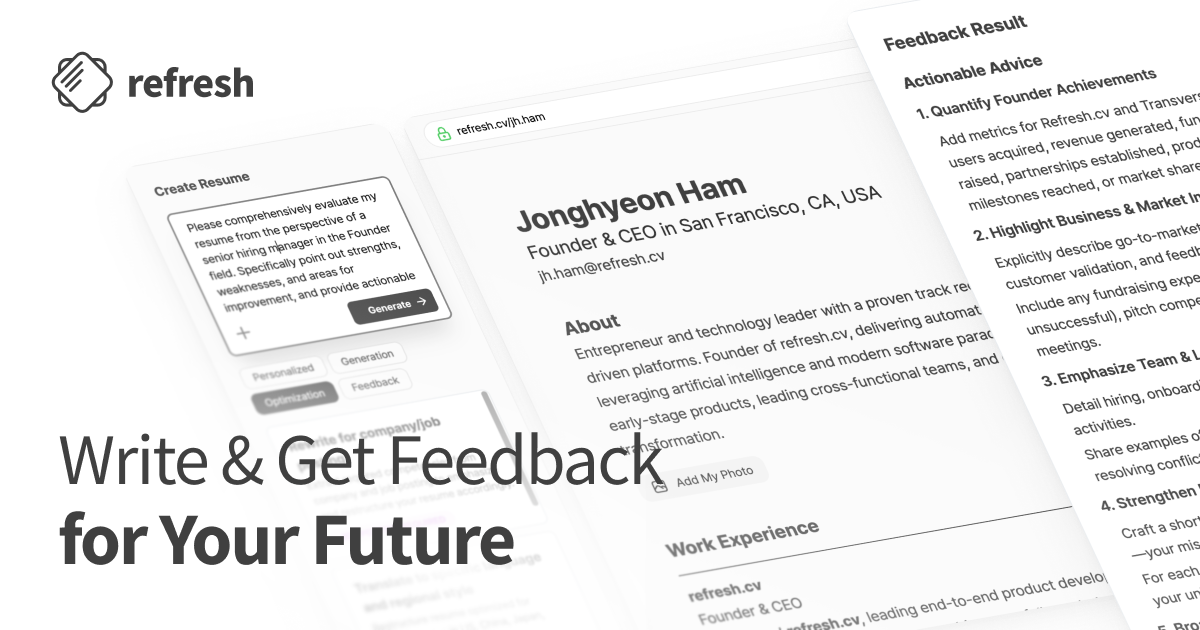
Inside refresh.cv, this comparison runs by pasting in a job posting and checking it against a resume, and the resume's own quality score (specificity, achievements, wording, grammar) comes back as a separate result from its keyword fit for that particular posting. A high quality score doesn't guarantee a strong keyword match for a given role, and the reverse holds too. Neither score is a hiring probability or an employer's actual ATS decision.
On the Free plan, AI writing and editing and resume score analysis are each available 5 times a month. Job-specific resume tailoring and ATS keyword analysis with improvement suggestions are part of the Pro plan ($14.99/month). If you're applying to three or four postings, it's reasonable to test the workflow on the free tier first.
If you want a starting framework for comparing tools before committing to one, our guide to choosing an AI resume builder for a career change covers the same evidence-matching approach in more general terms.
FAQ
Is it safe to publish internal metrics externally?
If the exact figure is sensitive, round it to something you're comfortable sharing publicly. "Terabyte-scale daily ingestion" instead of "1.2TB/day," or "several thousand RPS" instead of "4,200 RPS," still communicates the order of magnitude. Reporting the percentage of improvement instead of the absolute numbers works the same way.
What if I only participated in an incident response instead of resolving it directly?
Describe your actual role. Log collection, timeline assembly, reproduction testing, or writing the postmortem itself are all specific enough to stand on their own. The work of identifying contributing causes reads as operational experience even when you weren't the one who shipped the fix.
I'm early career and don't have a production incident to write about. What do I use instead?
Substitute load testing and failure-scenario design. Even a side project measured with k6 or JMeter, along with the RPS and p95 latency you recorded and the reasoning behind your timeout and retry settings, is evidence that you can talk in the same metric vocabulary an interviewer expects.
Should the resume and the longer work-history document repeat the same details?
Keep a single metric-driven line on the resume, and expand it into the full four-stage timeline (detection through prevention) in the longer document. Same incident, different depth.
Pick one job posting, paste it in, and run your own resume through the three-way comparison above. You can start directly at refresh.cv.
0
메일로 새 글 받기
이력서, 면접, 이직 준비와 커리어 성장에 관한 새 글을 이메일로 받아보세요.