6 AI Resume Builders Ranked by Evidence Matching

The gap between AI resume builders isn't how many missing keywords they find, it's whether they check if your resume actually has the experience to back those keywords up. We ranked refresh.cv, Jobscan, Teal, Rezi, Kickresume, and Enhancv on five criteria: how deeply each pulls requirements and ATS keywords from a job posting, whether it separates evidence you have from evidence you don't, whether it keeps resume quality and job fit as separate scores, template parsing safety, and pricing clarity.
We're the team that builds refresh.cv, so this comparison includes our own product. Rankings are built from each company's published documentation and pricing pages, and we did not assume a feature exists just because a competitor's site is silent on it.
Why Keyword Coverage Alone Doesn't Answer the Question
Large-company hiring runs through software before it runs through a person. According to Jobscan's 2026 ATS usage report, an applicant tracking system was detected at 97.4% of Fortune 500 companies (487 of 500), with Workday and SuccessFactors together accounting for more than half of that usage. So most AI resume tools converge on the same pitch: find the keywords in the posting and add them to your resume. That pitch quietly assumes you already have the experience behind every keyword, and for a lot of applicants, especially anyone changing roles or industries, that assumption doesn't hold.
Our Five Ranking Criteria
Run one job posting against your resume and every requirement in it falls into one of three buckets:
- Keyword and evidence both present. The work is already on your resume; you just need to match the posting's exact phrasing and add a result.
- Related experience exists, but the posting's wording doesn't. Your resume says "ran weekly release syncs" and the posting says "agile delivery experience." This is the only bucket where an honest rewrite is possible.
- Neither keyword nor evidence exists. Adding it anyway is a fabrication. The honest options are to leave it out or address the gap through other application prep.
A tool that only lists missing keywords can't tell bucket 2 from bucket 3. When it can't, users tend to fill in bucket 3 anyway. That's the exact failure mode Jobscan's keyword stuffing guide describes: a resume padded with terms the candidate can't back up, which recruiters learn to spot because the skills never connect to how they were actually used. Indeed's guide to resume keyword scanners gives the same advice from the other direction, recommending that generic phrasing get replaced with the posting's specific terms rather than keywords being appended as a list.
That's the basis for the five criteria below:
- How specifically the tool extracts requirements and ATS keywords from a pasted job posting
- Whether it separates the three evidence buckets above and prioritizes revisions accordingly
- Whether resume quality (specificity, achievements, wording, grammar) is scored separately from job-specific fit
- Whether the default templates use a parsing-safe structure
- Whether billing cycles and included usage are clearly published
| Rank | Tool | Separates the 3 evidence buckets | Job-specific keyword analysis | Quality score kept separate from fit | Published starting price |
|---|---|---|---|---|---|
| 1 | refresh.cv | Shown in-product | Extracted from a pasted job posting | Yes, shown separately | Free; Pro $14.99/mo |
| 2 | Jobscan | Not documented publicly | Match report against a named ATS | Centered on one match score | Check official pricing page |
| 3 | Teal | Not documented publicly | Match score against a saved posting | Bundled with an application tracker | Free tier available |
| 4 | Rezi | Not documented publicly | Keyword targeting with a live score | Centered on a single Rezi Score | Pro $29/mo; lifetime $149 |
| 5 | Kickresume | Not documented publicly | ATS check plus AI drafting | Centered on the check result | Check official pricing page |
| 6 | Enhancv | Not documented publicly | Content-analysis focused | Centered on a content report | Check official pricing page |
"Not documented publicly" means we couldn't find published documentation describing that distinction, not that the feature is confirmed absent. Every one of these products updates often, so confirm current features on the official page before paying.
1. refresh.cv: We Built the Workflow Around the Evidence Gap
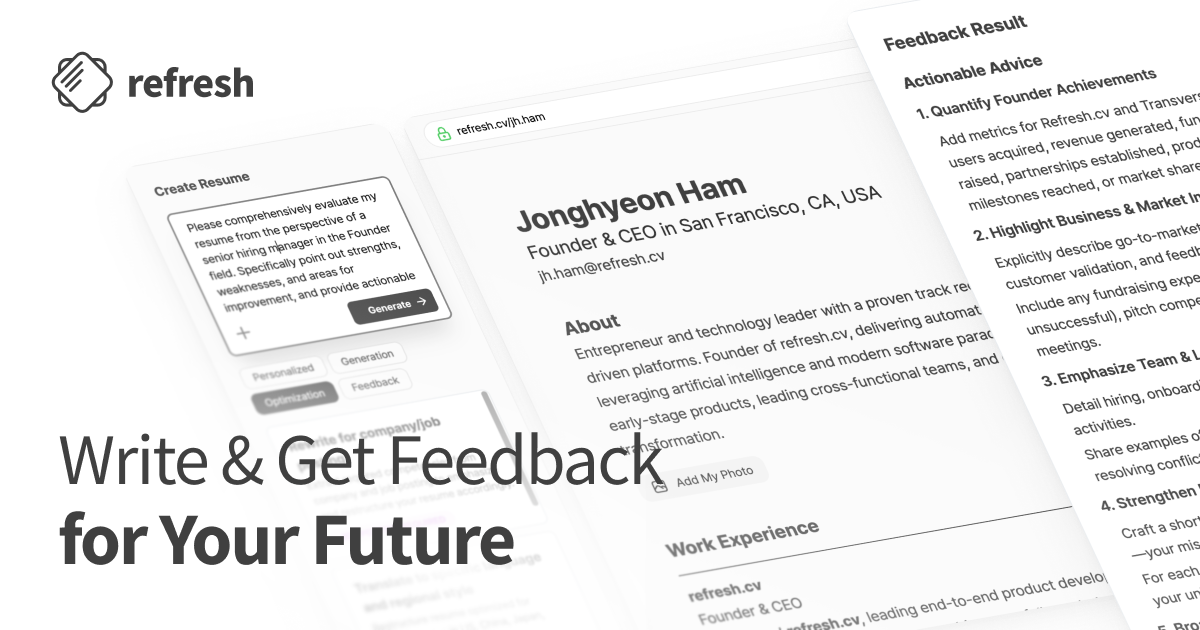
Our product runs one workflow: paste a job posting, extract its requirements and ATS keywords, then compare your resume's wording against the experience evidence actually written into it, sorted into the three buckets above. We don't suggest filling in experience you don't have; that's a deliberate design boundary, not a limitation we're working around.
We keep resume quality (specificity, achievements, wording, grammar) and job-specific keyword fit as two separate numbers, because they answer different questions. A high-quality resume can still miss a specific posting's requirements, and a resume tailored tightly to one posting can still read as generically written. Neither score predicts your odds of an interview or how a specific company's ATS will actually rank you.
Free includes resume and cover letter creation in English, Japanese, and Chinese, 5 AI writing/edit actions a month, 5 resume score analyses a month, starter templates, and a public resume page. Pro is $14.99/mo with unlimited resume and cover letter AI, unlimited score analysis, job-specific tailoring, and ATS keyword analysis with revision suggestions. Mock Apply, a supplementary feature for interview-adjacent application prep, is included at 1 use/month on Free and 10/month on Pro. Full current details are on the refresh.cv pricing page.
We'll name the gap too: we don't reverse-engineer which specific ATS a given employer runs, and we don't offer a kanban-style application tracker. If either of those is your immediate priority, the next two tools below cover that ground better than we do.
2. Jobscan: Go Here for ATS-Specific Match Depth
Jobscan has been running resume-to-posting match scores for years and layers on guidance tied to the specific ATS an employer uses. The same company backs that positioning with data: its own annual ATS usage report is one of the more frequently cited sources for how common ATS software actually is in large-company hiring.
Where the output falls short of ours is what happens after the match score. It tells you what's missing; it doesn't tell you whether your own background can honestly support adding it. That judgment call stays with you. Free scan limits and current plan pricing vary across secondary sources, so confirm both directly on Jobscan's pricing page before committing.
3. Teal: Pick This If You Need a Free Tier and an Application Tracker
Teal combines resume building, posting comparison, and saved-job/application tracking in one interface. Teal's own comparison page positions that all-in-one connection between writing, comparing, and tracking as its core differentiator, and it's a genuinely useful setup once your application volume climbs and a spreadsheet stops being enough.
Whichever tool you use for the comparison step, the check is the same: before you accept a suggested phrase, confirm your resume actually contains a project that backs it up.
4. Rezi: Pick This for Real-Time Scoring While You Write
Rezi is known for a live score that updates as you edit, keyword targeting, and parsing-conscious formatting. According to Teal's published comparison of resume tools, Rezi's plans run a free tier, Pro at $29/mo, and a lifetime option at $149, which can be the better math for a long job search if you'd rather not keep a subscription running.
A rising score and a factually accurate resume don't always move in the same direction. If you're padding a sentence to nudge the number up, checking whether the underlying evidence came along with it is still on you.
5. Kickresume: Pick This When You Need a Fast First Draft
Kickresume's large template library and AI drafting are genuinely useful for getting past a blank page. The tradeoff: AI-drafted sentences don't originate from your actual work history, so every line still needs to be rewritten against a real project before it goes out. When picking a template here, or from any resume tool that emphasizes design, stick to standard section headers and a simple body structure. That's a parsing-safety rule for the category, not something specific to Kickresume.
6. Enhancv: Pick This When Design Carries Real Weight
Enhancv leans into visually polished templates and content-improvement suggestions, which suits roles where a human is likely to open the actual document, portfolio-adjacent or design-facing positions especially. It isn't built around posting-by-posting keyword and evidence comparison, which is why it sits last against these specific five criteria.
One Job Posting, Rewritten Three Ways
Say a product manager posting asks for "agile delivery experience," "stakeholder management," and "SQL-based metrics analysis." Your resume currently says: "ran weekly release syncs," "aligned quarterly roadmap with sales and CS," and "participated in dashboard reviews."
A tool that only lists missing keywords flags all three as gaps, and the default move is to overwrite all three lines with the posting's exact language.
Splitting by evidence bucket changes the outcome:
- Agile delivery: evidence present, wording missing. Weak: "Ran weekly release syncs." Stronger: "Ran two-week sprint cycles with weekly release syncs, shipping 12 releases per quarter." Same fact, now in the posting's vocabulary with a concrete cadence attached.
- Stakeholder management: both present. Weak: "Aligned quarterly roadmap with sales and CS." Stronger: "Aligned quarterly roadmap across sales and CS organizations, resolving [number] competing feature requests per cycle." Add the scope a recruiter needs to judge the size of the work.
- SQL-based metrics analysis: evidence absent. Watching a dashboard and writing the SQL behind it are different skills. If you never wrote the query, don't claim you did. Instead, describe what decision you made from the metrics you did review, and handle any skill gap through a different part of your application, not an invented resume line.
Leaving that third line out is the actual decision this whole comparison is about. If you can't defend a sentence for 90 seconds in an interview, it doesn't belong on the resume.
Compare the Pricing Structure, Not Just the Number
Two tools at the same monthly price can include very different usage. Check four things before you subscribe: the billing cycle (weekly, monthly, annual, or lifetime), the cap on job-posting analyses and AI edits, whether that cap counts documents or analysis actions, and the cancellation and renewal terms. On refresh.cv, Free includes 5 AI writing/edit actions and 5 score analyses a month; Pro at $14.99/mo removes both caps; Max at $49.99/mo adds 50 Mock Apply uses a month (see the refresh.cv pricing page for current detail). Competitor pricing changes often, so treat the table above as a starting point and confirm on each official page.
If you want to narrow the comparison further, we've also written about how deep an AI resume tool's feedback actually goes and how to test any AI resume tool with one real job posting.
FAQ
What's the difference between a resume score and job fit?
A resume score evaluates the document itself: specificity, achievement framing, wording, and grammar. Job fit measures how well that same resume matches one specific posting's requirements and keywords. A resume can score well overall and still miss what one posting is asking for, which is why we keep the two numbers separate rather than blending them into one. Neither number predicts interview odds or an employer's actual ATS outcome.
Does adding more keywords always help?
No. Indeed's guidance is to replace generic phrasing with the posting's specific terms, not to append keywords as a list, since stuffing them in without context reads as exactly that. Jobscan's keyword stuffing guide makes the same point from the recruiter side: a resume that's mostly a skills list, disconnected from how those skills were actually used, tends to read as padded rather than qualified. Keywords carry weight only inside a specific, verifiable accomplishment.
Should I use more than one of these tools at once?
Plenty of job seekers pair a writing tool with a separate scanner and a tracker. The tradeoff is that your resume's source-of-truth splits across more places the more tools you add. Keeping your actual experience details in one place, and generating posting-specific versions from that single record, cuts down on the coordination cost.
What if I'm early-career and don't have much evidence yet?
Having a lot of requirements land in the "no evidence" bucket is normal at this stage. The useful next step is combing school projects, internships, and personal work for anything that genuinely overlaps a posting's requirements and can move into bucket 1 or 2. For whatever's left in bucket 3, use it to help decide whether the role is a reasonable stretch to apply for at all, rather than trying to write around it.
Pick one posting you're actually applying to and paste it into refresh.cv to see how its requirements stack up against your real experience evidence, on the free plan, before you decide on anything paid.
0
메일로 새 글 받기
이력서, 면접, 이직 준비와 커리어 성장에 관한 새 글을 이메일로 받아보세요.